
Incorporating Fenugreek Fiber in Functional Foods: Trends and Applications for Food Developers
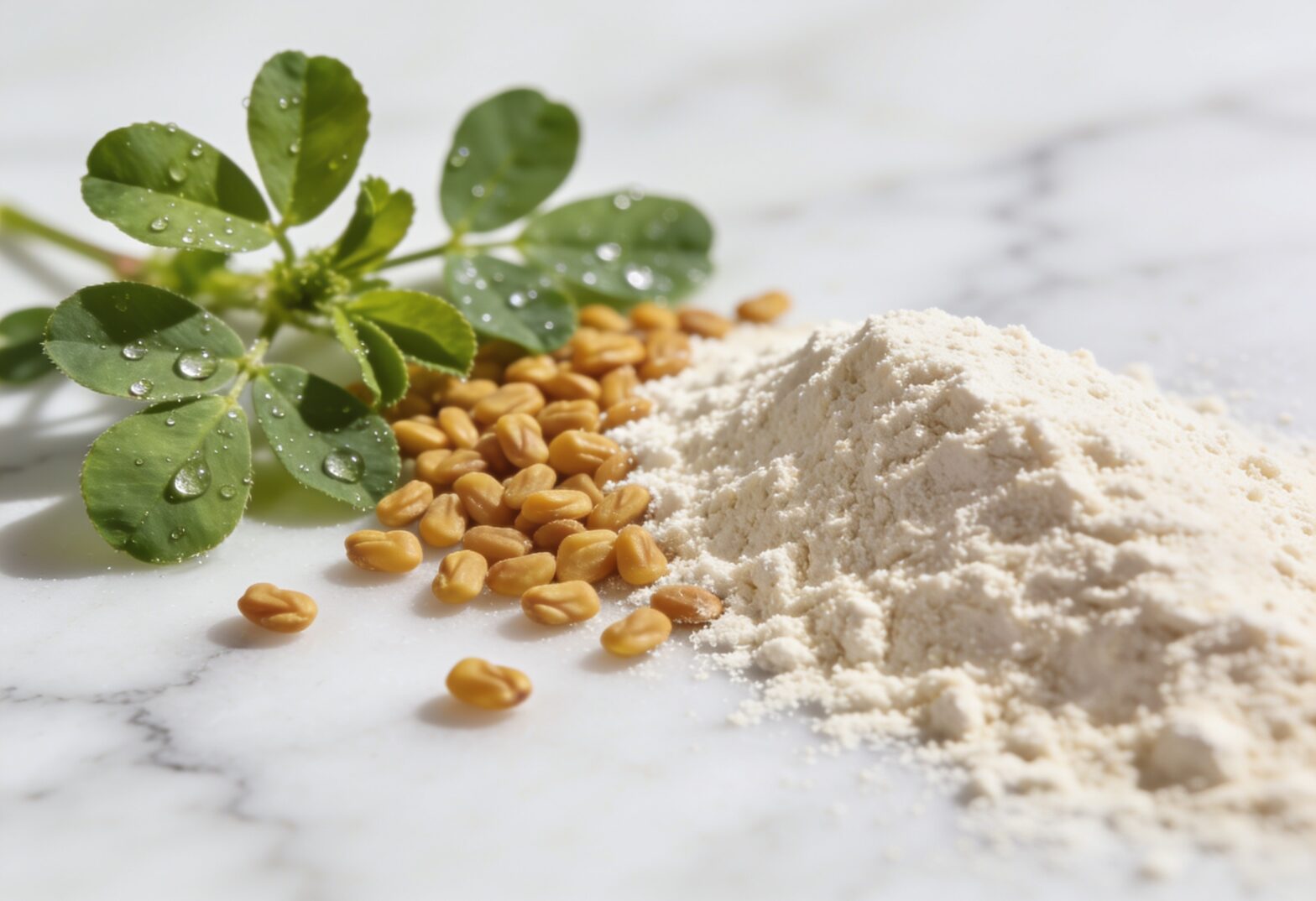
Fenugreek fiber helps food developers create functional foods that deliver digestive, metabolic, and clean-label benefits in a single ingredient. Derived from the seed endosperm of Trigonella foenum-graecum, this galactomannan-rich fiber brings viscosity and prebiotic activity to formulations across dairy, bakery, snacks, and beverages.
Sunita Hydrocolloids supplies fenugreek-derived ingredients, specifically SUNCOL-20FD fiber and SUNPRO-40FP protein, designed for food and nutraceutical formulations that need consistent hydrocolloid performance backed by third-party certifications.
TL;DR
- Fenugreek galactomannan fiber is gaining traction among food developers who want a single ingredient that handles both texture control and documented health benefits.
- The global fenugreek fiber market is projected to grow from USD 321.51 million in 2025 to USD 483.43 million by 2032 at roughly 6% CAGR.
- Fenugreek fiber works across dairy, bakery, snacks, and beverages at low inclusion levels because of its unusual cold-water hydration and high viscosity.
- Sunita Hydrocolloids’ SUNCOL-20FD gives R&D teams a standardized, certified galactomannan fiber built for these applications.
Fenugreek fiber 101 – what it is and why it’s different
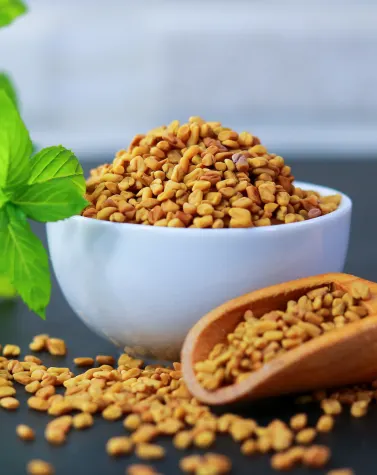
Fenugreek (Trigonella foenum-graecum) seed endosperm provides galactomannan fiber that functions as a soluble, highly hydrating hydrocolloid in food systems. It is this galactomannan, a polysaccharide built from mannose and galactose sugar units, that gives fenugreek fiber its functional identity.
What separates fenugreek from guar, locust bean, or tara gum is its unusually low mannose-to-galactose ratio, sitting close to 1:1. That ratio matters because it allows fenugreek galactomannan to hydrate rapidly in cold water without needing heat activation. The practical result: you get high viscosity at low inclusion levels, which means fewer formulation headaches when you’re working with temperature-sensitive systems or trying to keep costs in check. For developers asking “why fenugreek over generic fibers?” the answer starts with that cold-hydration advantage and the dual positioning as both a functional food ingredient and a documented dietary fiber.
Evidence-backed health functions of fenugreek galactomannan
1. Supports digestive health
Fenugreek galactomannan supports digestive health by acting as a prebiotic substrate that increases short-chain fatty acid production in the colon, feeding beneficial gut bacteria more effectively than many conventional dietary fibers.
2. Lowers LDL
It lowers LDL cholesterol by binding bile salts in the intestine, forcing the liver to pull cholesterol from the bloodstream to produce replacement bile. This mechanism supports reduced cardiovascular risk over time.
3. Lowers blood sugar spikes
On glycemic control, fenugreek galactomannan slows carbohydrate digestion by prolonging gastric emptying and inhibiting intestinal enzymes like alpha-amylase and sucrase, which lowers post-prandial blood sugar spikes and reduces the overall glycemic index of foods containing it.
4. Helps with weight management
Weight management ties back to the same viscosity: the gel fenugreek fiber forms in the stomach, promoting satiety by delaying gastric emptying.
Market and consumer trends behind fenugreek fiber adoption
Why is fenugreek fiber growing now? Two forces are converging.
Clean-label demand keeps climbing, and food manufacturers need natural hydrocolloids with real performance data behind them. The global fenugreek fiber market was valued at USD 321.51 million in 2025 and is projected to reach USD 483.43 million by 2032, growing at roughly 6% CAGR. A separate projection from Future Market Insights estimates growth from USD 184.4 million in 2026 to USD 262.6 million by 2036 at 3.6% CAGR. The gap between projections comes down to how different analysts segment the market.
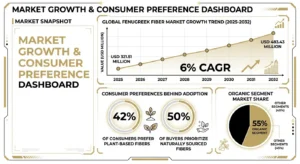
On the demand side, approximately 46% of manufacturers already integrate fenugreek fiber for its gelling, thickening, and stabilizing properties, and more than 50% of ingredient buyers now prefer naturally sourced fibers over synthetic alternatives. The organic segment holds about 55% market share, food and beverage applications account for around 20% of consumption, and China leads projected growth among regional markets. That last point is worth watching for companies planning Asia-Pacific expansion.
Clean-label, plant-based and gut-health positioning
Fenugreek fiber sits at the intersection of three consumer mega-trends that show no sign of slowing. Roughly 42% of consumers actively prefer plant-based fibers when given the choice, and 38% choose natural fiber supplements over synthetic options. When you combine that with more than half of buyers prioritizing naturally sourced fibers at purchase, the commercial case for fenugreek becomes hard to ignore.
Consumers choose fenugreek fiber because it is plant-derived, supports gut health through prebiotic effects, and fits the clean-label expectations that dominate new product launches. Developers should frame benefits carefully. Use language like “supports digestive health,” “is associated with improved glycemic response,” or “may help maintain healthy cholesterol levels” rather than making disease-treatment claims. That regulatory discipline protects both the brand and the consumer.
Application playbook – where fenugreek fiber delivers the most value
Think of this section as an application map. If you’re an R&D manager asking “how do I use fenugreek fiber in yogurt, bakery, snacks, or beverages?” each subsection below gives you a mini how-to pattern with directional usage benchmarks.
The four main territories are dairy and dairy alternatives, bakery and cereal, snacks and fried foods, and beverages and nutritional drinks. Sunita’s SUNCOL-20FD plugs into each of these categories as a soluble galactomannan that controls viscosity and texture while contributing targeted nutritional value.
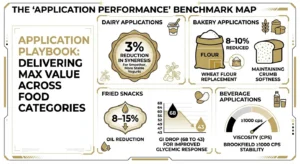
1. Dairy and dairy alternatives – creaminess, stability and syneresis control
Fenugreek fiber is a natural hydrocolloid that stabilizes dairy systems by forming viscous solutions and reducing whey separation. In yogurt applications, research indicates around 3% reduction in syneresis when fenugreek fiber is included, which translates to a smoother, creamier product with less liquid pooling on the surface.
For dairy alternative developers, the cold-hydration behavior of fenugreek galactomannan is particularly useful. You can build body and mouthfeel in plant-based milks without heat processing steps that degrade delicate flavor profiles. SUNCOL-20FD hydrates rapidly enough to manage rheology in dairy-style systems similar to other SUNCOL hydrocolloid grades used in yogurts and dairy desserts. Start with low inclusion levels, validate viscosity and syneresis in bench trials, then dial in sensory through pilot batches.
2. Bakery and cereal – boosting fiber while preserving texture
The practical question for bakery developers is always “how much can I add before texture falls apart?” Research shows that 8 to 10% replacement of wheat flour with fenugreek fiber in bakery products maintains acceptable texture. In muffin trials, fenugreek husk inclusion roughly doubled total fiber content while keeping the crumb soft and the eating experience intact.
Fenugreek fiber increases total dietary fiber in finished goods while maintaining dough handling and crumb softness when used at moderate substitution levels. The mechanism is straightforward. The galactomannan absorbs water, improves moisture retention during baking, and works as a structural aid in the crumb matrix. For teams working with SUNCOL-20FD, prototype at 5 to 10% substitution, then monitor bake spread, crumb structure, and consumer acceptance before scaling.
3. Snacks and fried foods – oil uptake and glycemic response
Two numbers capture the opportunity here. Fenugreek fiber reduces oil absorption by 8 to 15% in fried foods by forming a viscous barrier at the food-oil interface during frying. And when roughly 15% fenugreek polysaccharide was incorporated into snack formulations, glycemic index dropped from 68 to 43 in test conditions, a meaningful shift for products targeting health-conscious consumers.
These values come from controlled test environments and should be treated as directional benchmarks, not guaranteed results across every formulation. Oil absorption depends on frying temperature, batter composition, and product geometry. Still, the directional signal is strong enough to justify trial work. Developers can pair SUNCOL-20FD with Sunita’s broader hydrocolloid expertise to tune crunch, expansion, and oil binding for specific snack formats.
4. Beverages and nutritional drinks – viscosity control and digestive benefits
Fenugreek galactomannan increases beverage viscosity at low doses, which improves mouthfeel and suspension stability. For smoothies, juices, milkshakes, and nutritional drinks, even small additions of fenugreek fiber contribute meaningful dietary fiber per serving alongside digestive support.
Fenugreek-type gums are generally stable across a broad pH range and typical processing temperatures, making them suitable for both acidic fruit-based drinks and neutral dairy-style beverages. Over-thickening is the main risk, so start at low inclusion levels and use SUNCOL-20FD’s viscosity specs (Brookfield ≥1000 cps under defined conditions) to guide dose selection. A little goes a long way with this ingredient.
Formulation criteria and specification checklist for fenugreek fiber ingredients
When evaluating fenugreek fiber suppliers, here is what your spec sheet should cover.
Product developers select fenugreek fiber suppliers based on viscosity specification, microbiological safety, and third-party certifications.
For SUNCOL-20FD specifically, the parameters to check include soluble galactomannan minimum content, viscosity at Brookfield ≥1000 cps under defined measurement conditions, particle size passing through US ASTM 60 mesh, acceptable pH range, moisture and ash limits, heavy metal thresholds, and microbiological compliance (total plate count, yeast, mold, coliforms, E. coli, Salmonella).
On the certification and compliance side, confirm Halal certification, Kosher certification, FSSC 22000 food safety management, and alignment with global food regulations for hydrocolloids. Sunita Hydrocolloids holds all four, which simplifies qualification for pharmaceutical and nutraceutical applications as well as food use.
Practical development workflow – from concept brief to scale-up
Integrating fenugreek fiber into a new product follows a logical four-step path.
First, define your nutrition and texture targets. How many grams of fiber per serving? What glycemic positioning? What viscosity range works for your product format? These numbers drive everything downstream.
Second, shortlist fenugreek fiber grades that match those targets. Compare viscosity specs, particle size, and certification requirements across suppliers.
Third, run bench trials to dial in dose and process conditions. R&D teams specify viscosity targets, then select the fenugreek fiber grade that meets those targets under real process conditions: shear rates, temperatures, and pH values that mirror your production line.
Fourth, validate sensory acceptance, shelf-life stability, and regulatory compliance before committing to scale-up. Collaborate with Sunita’s technical support team for fine-tuning inclusion levels and managing interactions with other hydrocolloids in your formula. They maintain dedicated application and R&D resources for exactly this kind of work.
Takeaways for formulation and innovation teams
Fenugreek galactomannan does what most plant fibers cannot. It hydrates in cold water, reaches high viscosity at low dosage, and carries a health-benefit profile that covers digestion, glycemic control, and cholesterol management. Consumer and market signals strongly favor natural, clean-label fibers, and the 6% annual growth projection for fenugreek fiber confirms this is not a niche trend.
Fenugreek fiber allows developers to deliver digestive and metabolic benefits while preserving enjoyable texture in mainstream food products. SUNCOL-20FD and SUNPRO-40FP from Sunita Hydrocolloids are ready-to-use, certified ingredient options backed by technical application support.
If your team is exploring fenugreek fiber for a new functional food project, reach out to Sunita Hydrocolloids for technical discussions, samples, and formulation guidance. The ingredient has the data behind it. The question is how you apply it.