
Exploring the Unique Galactomannan Structure of SUNCOL-20FD: Benefits Beyond Conventional Soluble Fibers
SUNCOL-20FD delivers measurable health and formulation benefits because its galactomannan structure is fundamentally different from conventional soluble fibers.
Produced by Sunita Hydrocolloids, a company with over 40 years in the hydrocolloid industry, this fenugreek-derived ingredient has earned a distinct position in the food, pharmaceutical, and nutraceutical sectors. What makes it unusual is the molecular architecture: a 1:1 mannose-to-galactose ratio that does not exist in other commercial galactomannan sources.
TL;DR
- SUNCOL-20FD is a fenugreek-derived soluble fiber with a rare 1:1 mannose-to-galactose ratio in its galactomannan backbone.
- This structural pattern sets it apart from conventional soluble fibers like guar gum or locust bean gum, giving it faster cold-water hydration, stronger viscosity at lower doses, and research-backed metabolic benefits.
- Those benefits include improved digestive health through short-chain fatty acid production, cholesterol reduction via bile salt binding, and better glycemic control by slowing gastric emptying.
- Manufactured by Sunita Hydrocolloids, SUNCOL-20FD is used by food, pharmaceutical, and nutraceutical formulators who need a single ingredient that works as both a technical hydrocolloid and a metabolic dietary fiber.
SUNCOL-20FD and Its Fenugreek Origin – A Brief Overview
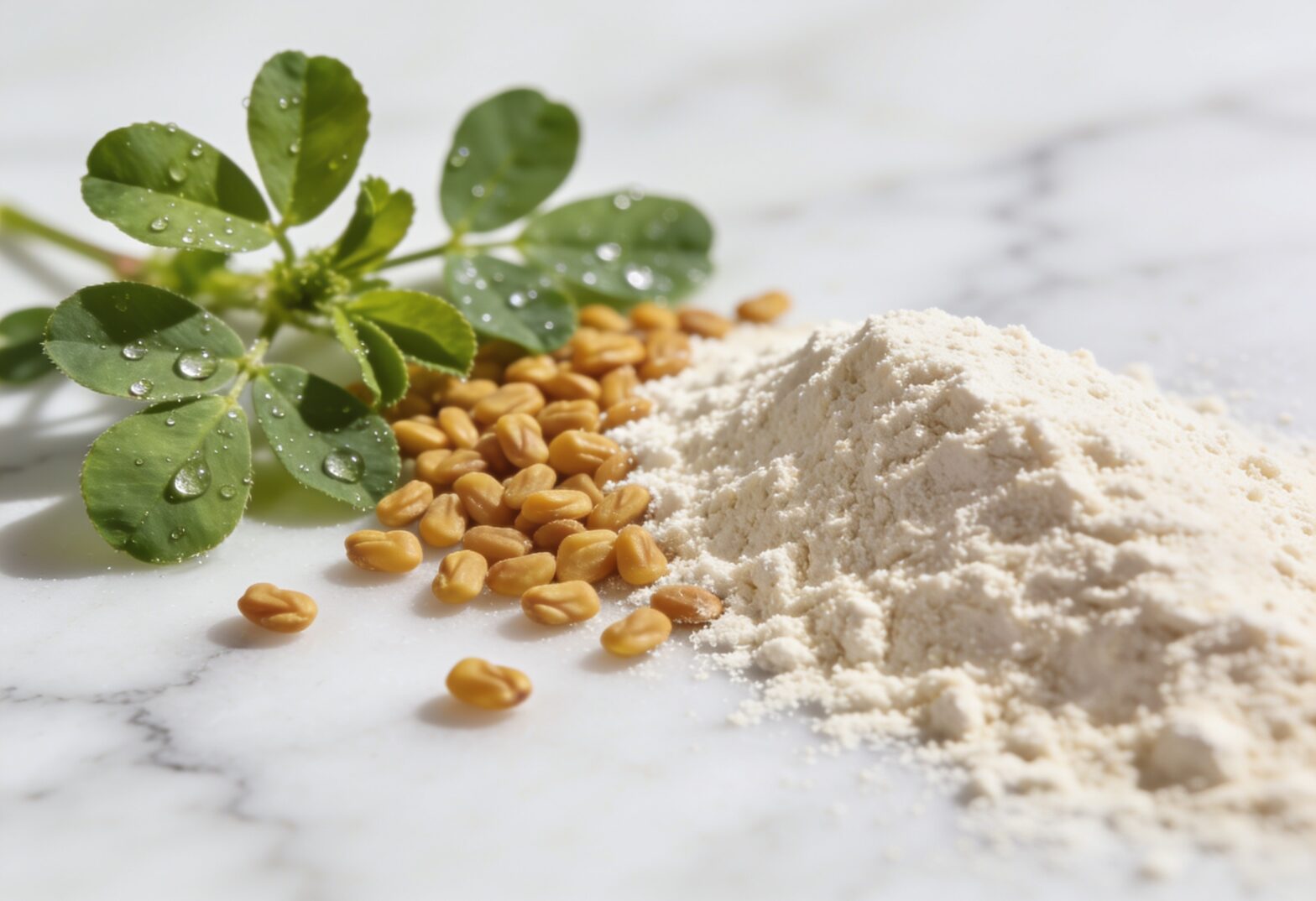
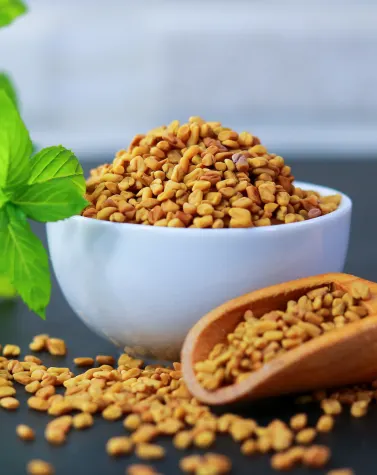
Fenugreek (Trigonella foenum-graecum) is an annual leguminous herb cultivated across India, parts of Europe, Africa, and the United States. Its seeds and leaves have appeared in food and traditional medicinal preparations for centuries, documented in Ayurvedic and Chinese medicine systems dating back thousands of years.
Sunita Hydrocolloids isolates the fenugreek seed endosperm to obtain water-soluble galactomannan, which is marketed as SUNCOL-20FD. The remaining seed fractions are refined into SUNPRO-40FP, a protein concentrate, so nothing goes to waste. The finished product is a pure, non-GMO, off-white galactomannan fiber powder, odorless, with a minimum 80% soluble fiber content. It is used as a dietary fiber ingredient in applications ranging from fiber-enriched dairy desserts to nutraceutical capsules and pharmaceutical tablet formulations.
Galactomannan 101 – How Structure Drives Function in Soluble Fibers
Galactomannans are polysaccharides built from a linear mannose backbone with galactose units branching off as side chains. They occur naturally in the seeds of several leguminous plants, including guar, locust bean, and fenugreek. But not all galactomannans behave the same way.
Galactomannan structure determines hydration speed, viscosity build, and interaction with water, which together define how a soluble fiber performs both in the gut and in food matrices. Most commercial galactomannans carry higher mannose-to-galactose ratios. Guar gum sits around 2:1, while locust bean gum ranges from 3.5:1 to 4:1. SUNCOL-20FD, by contrast, features a 1:1 mannose-to-galactose ratio, meaning galactose side chains are distributed far more densely along the backbone.
That density is the central thesis here: SUNCOL-20FD’s structural pattern explains its performance advantages over conventional soluble fibers that lack this specific architecture.
Conventional Soluble Fibers vs. Fenugreek Galactomannan
Typical galactomannans, and other plant-based soluble fibers, vary widely in their backbone-to-side-chain ratios and substitution density. Lower galactose substitution (like in locust bean gum) leaves stretches of the mannose backbone exposed, which encourages chain-to-chain hydrogen bonding. That is useful for gelling, but it also means slower hydration and reduced cold-water solubility.
Typical galactomannans provide viscosity and some metabolic benefits, but fenugreek galactomannan has a higher galactose substitution density, which Sunita associates with stronger effects on blood sugar and cholesterol management. To be clear, “benefits beyond conventional soluble fibers” here means more potent metabolic effects demonstrated specifically for fenugreek galactomannan, not a blanket superiority claim. All soluble fibers contribute to health; SUNCOL-20FD is highlighted for its unique galactomannan pattern and the evidence supporting it.
The 1:1 Mannose:Galactose Architecture of SUNCOL-20FD
SUNCOL-20FD is the only commercial galactomannan source where backbone mannose units exist in a 1:1 ratio with galactose side chains. In practical terms, nearly every mannose unit along the backbone carries a galactose branch. This dense substitution prevents hydrogen bonding between adjacent mannose chains. That is precisely why fenugreek galactomannan dissolves readily in cold water, even at low concentrations.
The structural consequence is direct: more hydration sites and stronger water binding, which means reliable viscosity formation without requiring heat or extended mixing. SUNCOL-20FD’s 1:1 mannose-to-galactose structure enables rapid cold-water hydration, producing uniform viscosity and smooth texture across formulations as different as beverages, baked goods, and pharmaceutical suspensions.
From Structure to Health Outcomes – Mechanisms of Fenugreek Galactomannan
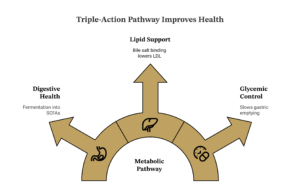
The connection between SUNCOL-20FD’s structure and its health benefits runs through three main pathways: digestive health via short-chain fatty acid production, lipid profile improvement through bile salt binding, and glycemic control by slowing gastric emptying and sugar absorption.
Fenugreek galactomannan improves digestive health by increasing short-chain fatty acid output compared with other fibers. It lowers cholesterol by exerting bile salt-binding and cholesterol-reducing effects. And it slows gastric emptying, which delays sugar absorption and moderates post-meal blood glucose spikes. Scientific evidence supports these mechanisms specifically for fenugreek galactomannan, though formulation-level claims must always align with local regulatory frameworks.
Digestive Health and Short-Chain Fatty Acids
SUNCOL-20FD supports digestive health primarily through an increased proportion of short-chain fatty acids (SCFAs) when compared with other dietary fibers. Fenugreek galactomannan resists gastric acid and pancreatic enzyme hydrolysis, so it reaches the colon intact. Once there, beneficial bacteria ferment it into butyrate, propionate, and acetate. Research published in Food Science & Nutrition confirmed that fenugreek galactomannan was fermented and utilized at 71.4% by probiotic bacteria, with significant SCFA production observed.
SUNCOL-20FD promotes SCFA production because its galactomannan is highly fermentable, which in turn supports gut barrier integrity, bowel regularity, and overall digestive comfort.
Cholesterol and Lipid Profile Support
Fenugreek galactomannan enters the cholesterol conversation through its interaction with bile salts. The galactomannan fibers bind bile acids in the intestine, reducing their reabsorption and forcing the liver to pull cholesterol from the bloodstream to synthesize replacement bile. The result: lower total cholesterol and reduced LDL levels.
Pre-clinical studies suggest that fenugreek galactomannan may lower cholesterol, reducing cardiovascular risk markers in the process. Lower LDL and improved lipid profiles contribute to heart health, though these findings place fenugreek galactomannan in a supportive, risk-reducing role rather than a therapeutic one.
Glycemic Index, Satiety and Diabetes-Oriented Formulations
Scientific evidence suggests that fenugreek galactomannan prolongs stomach emptying time so that sugar is released and absorbed more slowly. This mechanism is particularly relevant for diabetic patients and those managing blood sugar levels. Clinical studies have shown that food preparations containing fenugreek fiber had glycemic index values below 50%, significantly lower than the same preparations without fenugreek.
Incorporating fenugreek galactomannan into a food formulation lowers that product’s glycemic index compared with the same food without it, supporting both weight management and glycemic control. For developers designing low-GI or diabetes-supportive products, SUNCOL-20FD is a practical ingredient choice, though benefits should be positioned as adjunctive rather than curative.
Functional Advantages of SUNCOL-20FD vs Conventional Soluble Fibers in Formulations
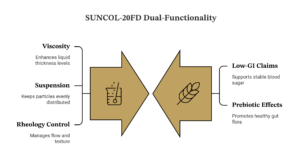
Why choose SUNCOL-20FD instead of a generic soluble fiber? It comes down to dual functionality. SUNCOL-20FD behaves as a soluble hydrocolloid that hydrates quickly in water, achieves defined viscosity at low use levels, and contributes to smooth texture in complex food systems. Conventional fibers often require higher doses or longer hydration times to reach comparable viscosity profiles.
What matters most to formulators is that SUNCOL-20FD is both a technical hydrocolloid for rheology control and a metabolic dietary fiber for label claims. That dual function simplifies the ingredient deck and the formulation strategy.
Hydration, Viscosity and Process Performance
SUNCOL-20FD delivers a minimum Brookfield viscosity of 1,000 cps (1% solution, 2 hours) and is designed to hydrate in cold water to build uniform viscosity with standard agitation. It disperses and hydrates to target viscosity without requiring specialized equipment, so formulators can manage flow, suspension, and stability in standard production environments. Formulation teams should monitor hydration time, shear conditions, and final viscosity to align with specific equipment setups and product requirements.
Sensory and Stability Benefits Across Food and Nutraceutical Formats
SUNCOL hydrocolloids are already used across ice creams, yogurt, sauces, bakery products, noodles, salad dressings, canned foods, and soups. SUNCOL-20FD extends this portfolio as a fenugreek-based soluble fiber option.
SUNCOL-20FD adds body and smoothness to finished products, improving mouthfeel in a noticeable way. It also helps control phase separation and sedimentation in emulsions and suspensions. Typical applications include fiber-enriched dairy desserts, functional beverages, nutritional bars, and baked goods, though it works well in any system where viscosity, texture, and fiber content matter.
Specification and Quality Checklist for SUNCOL-20FD
For procurement and quality teams evaluating SUNCOL-20FD, here are the core specifications: plant species is Trigonella foenum-graecum; appearance is an off-white, odorless powder; non-GMO compliant. Composition targets include soluble fiber as galactomannan at minimum 80%, total ash no more than 2%, protein no more than 5%, fat no more than 1%, and acid-insoluble residue no more than 4%.
Functional specs: Brookfield viscosity (1% solution, 2 hours) of minimum 1,000 cps; pH range of 6–7; particle size with minimum 80% passing through US ASTM 60 mesh. Heavy metals limits include arsenic, lead, mercury, and cadmium within stated ppm thresholds. Microbiological standards require total plate count under 5,000 cfu/g, yeast and mould under 100 cfu/g, and pathogens absent.
SUNCOL-20FD is packed in 25 kg multi-wall bags or HDPE drums. Users store it in cool, dry, ventilated areas away from heat sources. Shelf life extends up to 36 months from manufacture under proper storage conditions.
Key Takeaways – Why SUNCOL-20FD’s Galactomannan Structure Matters
SUNCOL-20FD’s 1:1 mannose-to-galactose galactomannan structure delivers rapid hydration, strong viscosity, and evidence-backed benefits for digestion, cholesterol, and glycemic control. All of that from a single, non-GMO ingredient.
Food and nutraceutical developers choose SUNCOL-20FD when they need one ingredient that acts as both a technical hydrocolloid and a metabolic soluble fiber. Sunita Hydrocolloids backs this choice with strict specifications, global quality certifications (FSSC 22000, ISO 9001, HALAL, KOSHER), and over four decades in the industry.
To explore SUNCOL-20FD’s technical data sheets and application guidance, visit the SUNCOL-20FD product page or connect with Sunita’s technical team directly.